Everything you run sits on the same foundation.The top of the stack gets the attention and the dashboards.The foundation gets ignored once it is installed.
Uncomfortable truth
Your monitoring server is also a Linux server.
root@monitoring-01:~# apt list --upgradable
Listing... Donelinux-image-generic[upgradable]openssl[upgradable]php8.3-fpm[upgradable]... 144 more
Who monitors the monitor?
And who patches it?
Why this matters now
Attackers patch-diff faster than we patch.
0%
of intrusions started with an exploit. The top initial vector for the sixth year running.
Mandiant M-Trends 2026
−7 days
Mean time to exploit in 2025. Exploitation now routinely starts before a patch exists.
Mandiant M-Trends 2026 (estimate)
0
Linux kernel CVEs in 2026 so far, about 180 a week. All of 2025: 5,924.
NVD API, kernel.org CNA, 1 Jan to 17 Nov 2026
0 Linux kernel bugs added to CISA's exploited list in 2026
Including CVE-2018-14634, added in January 2026. An eight-year-old kernel bug, still being exploited.
October 2026: PHP2Shell
CVE-2026-109618 and 109619. Unauthenticated RCE in PHP itself, CVSS 9.2, in CISA's exploited list five days after the fix.
Sources: cloud.google.com/blog/topics/threat-intelligence/m-trends-2026 · services.nvd.nist.gov (kernel.org CNA, by publish date) · CISA KEV catalogue v2026.11.17 · php.net/archive/2026.php · Verizon DBIR 2025: exploitation was the initial vector in 20% of breaches, up 34%
Eat
Sleep
CVE
Patch
Repeat. every week, now
How it started
August 2025
The itch
On holiday, worrying about the Linux servers back home. No clear view of what needed patching, or of their status.
18 September 2025
The first release
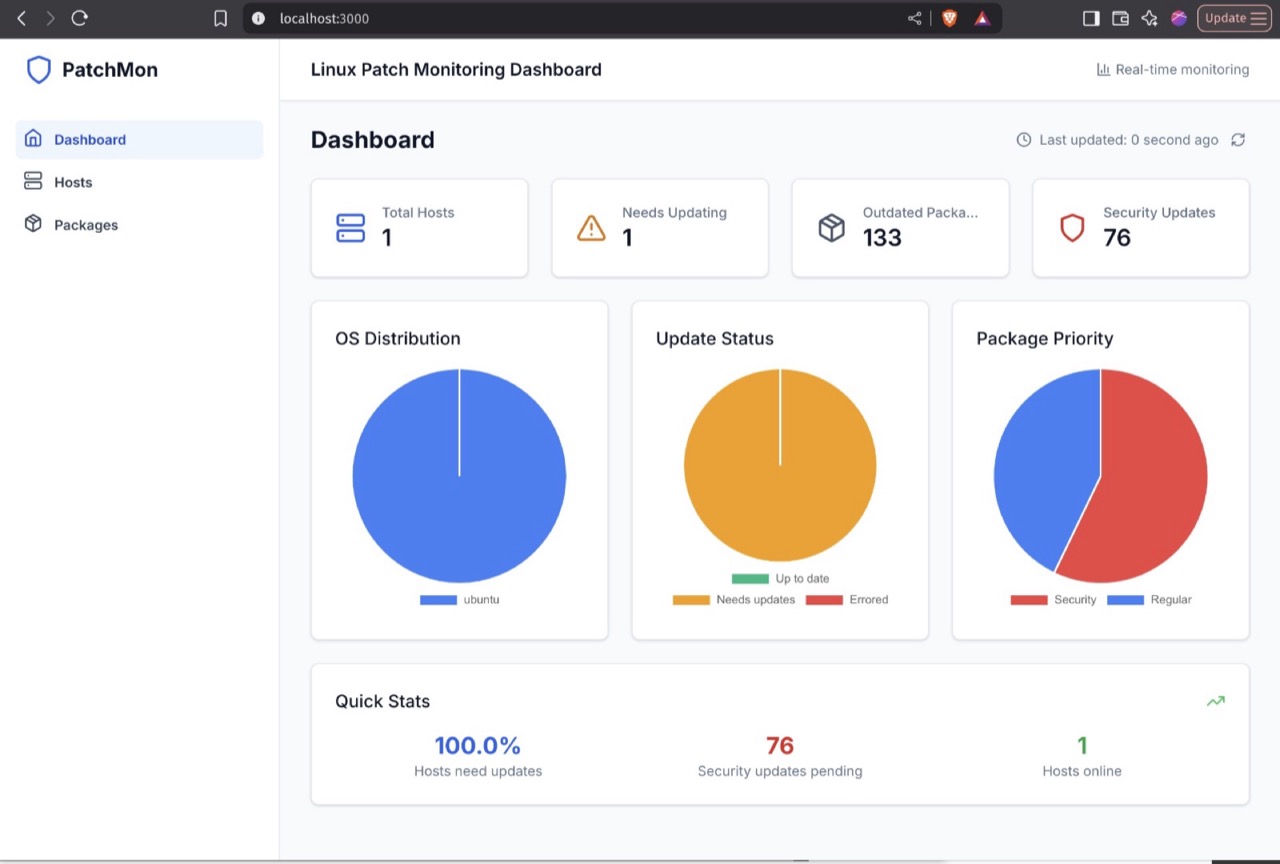
A simple dashboard. It didn't even have a login system.
Please do not do this in production. We have since added a login.
Sysadmins before going on holiday
Then it took off.
The community
People showed up, and built it with us.
0
GitHub stars
0
Discord members
0
Code contributors on GitHub
0
Forks
Discord admins
Volunteers who run the server and answer questions at all hours.
Code contributors
Features, refactors and whole integrations from the community.
🐛
Bug hunters
Reports and fixes, often with the patch attached.
🧪
Testers
Every release candidate tried on real fleets first.
Docker images
The first production-grade containers.
Helm and Kubernetes
Charts so it runs where you already run things.
GitHub Actions
CI that builds and checks every change.
SSO / OIDC
Login with the identity provider you already use.
What others are saying
From the people who bought us a coffee.
I do not have time and skills to contribute with active development, but your product and the level of service you are providing is really amazing. I trust patchmon will be recognized as best in class solution in its segment soon!
XMXNXS
Before I retired I was a cybersecurity manager so the addition of compliance scans takes this to a completely different level.
Chris McMahon
I'm using it in my homelab with almost 50 virtual hosts and it runs just perfect.
Ulf Klose
Wow, the v2.0 is a game changer. I really hope patchmon keeps growing.
Madoka
Love the patching feature! Thanks for this great work!
MarkusG.
Sehr cooles Tool mit aktiver Weiterentwicklung. Danke dafür!
a supporter
Thanks, you and your team are doing IT magic.
Someone
Ich mag Leute die eine Idee verwirklichen :-)
nop
I appreciate your work on this. The world needs open source.
Matt
very useful tool, great execution.
os2mac
Lesson learned
GitHub issues became a junk drawer.
Bugs GitHub issues
Ideas feedback.patchmon.net
Chat Discord
#101 Agent crashes on Alpine
#102 Feature request: dark mode pls
#103 How do I install this??
#104 Idea: Windows support
#105 Thank you, love it!!
#106 500 error on hosts page
#107 Integrate with Checkmk?
#108 Anyone running this on a Pi?
Adoption, anonymous telemetry
A year in, it's everywhere.
0
Hosts running the PatchMon agent
across all reporting instances
0
PatchMon instances
reporting in the last 365 days
0
Checkmk users running PatchMon
Challenge #1: reaching the hosts
Most tools have to reach in. Your network says no.So the agent reaches out instead.One connection, events both ways.
Firewall rules, NAT port forwards, and a Pi whose IP changes every day.Outbound HTTPS is allowed almost everywhere, so the agent opens the WebSocket.The server pushes patch runs down the same connection the agent opened.Only outbound 443. No inbound rules, no port forwards, no static IP, no VPN.
How the platform evolved
built withBashHTML / CSSGoNode.jsReactPostgreSQLDockerRedis
HTTP POST on a timerWebSocket, events both waysreports in, patch runs out
AGENT
Bash scriptGo binary
cron + curl, Linux onlyone static binary, outbound only
SERVER
APINode.js serverGo server
takes the reportExpress + PrismaExpress + Prisma, Redis queuesone binary: API, UI and migrations
UIUI, INSIDE THE BINARY
HTML, CSS, chartsReact + Chart.jsReact as static files
built with Viteembedded with go:embed
DATA
DatabasePostgreSQL
Linux amd64arm64386armFreeBSDWindows (beta)Linux patchingWindows, Alpine, openSUSE patchingmacOS, 1 Jan 2027
Before the repo: a bash script posts JSON to an API, which draws some charts.First release: a Node.js server (Express, Prisma), a React UI and PostgreSQL.Proxmox LXC auto-enrolment: new containers enrol themselves.The agent becomes a Go binary with a WebSocket: request and response becomes event driven.The agent learns compliance: OpenSCAP and Docker Bench.Checkmk integration, after meeting Mattias at FOSDEM.v2.0: the server is rewritten in Go, the UI ships inside it, and it starts patching Linux.Ansible dynamic inventory joins the integrations.Windows, Alpine and openSUSE patching.Next: macOS joins on 1 January 2027.
Deployment
From "run this script as root" to one line.
Sep 2025
Native install
setup.sh on bare metal bootstraps the OS, the app, the database and the config. One server, one shell session.
Sep 2025 · v1.2.6
Docker Compose
Contributed by the community. Today the default: same image everywhere, upgrades are a pull.
Oct 2025
Proxmox community script
Written by the community in community-scripts/ProxmoxVE: one command on the Proxmox host builds a PatchMon LXC.
Docker, any Linux host
mkdir patchmon && cd patchmon
bash -c "$(curl -fsSL https://raw.githubusercontent.com/PatchMon/PatchMon/refs/heads/main/docker/setup-env.sh)"
One Go server, 4,000 live agents: ~232 MiB and 8% CPU, with about 4,000 WebSockets open.
Measured 18 Nov 2026 on one laptop (Docker, arm64): v1.4.2 vs v2.1.8 server; v1.2.8 bash agent vs v2.1.8 Go agent on Debian 12 with 136 packages. The full v2 report is bigger (79 KB, it now carries descriptions and repositories) but is only sent when something changes. Load test: August 2026.
Platform over time
Progress, not perfection.
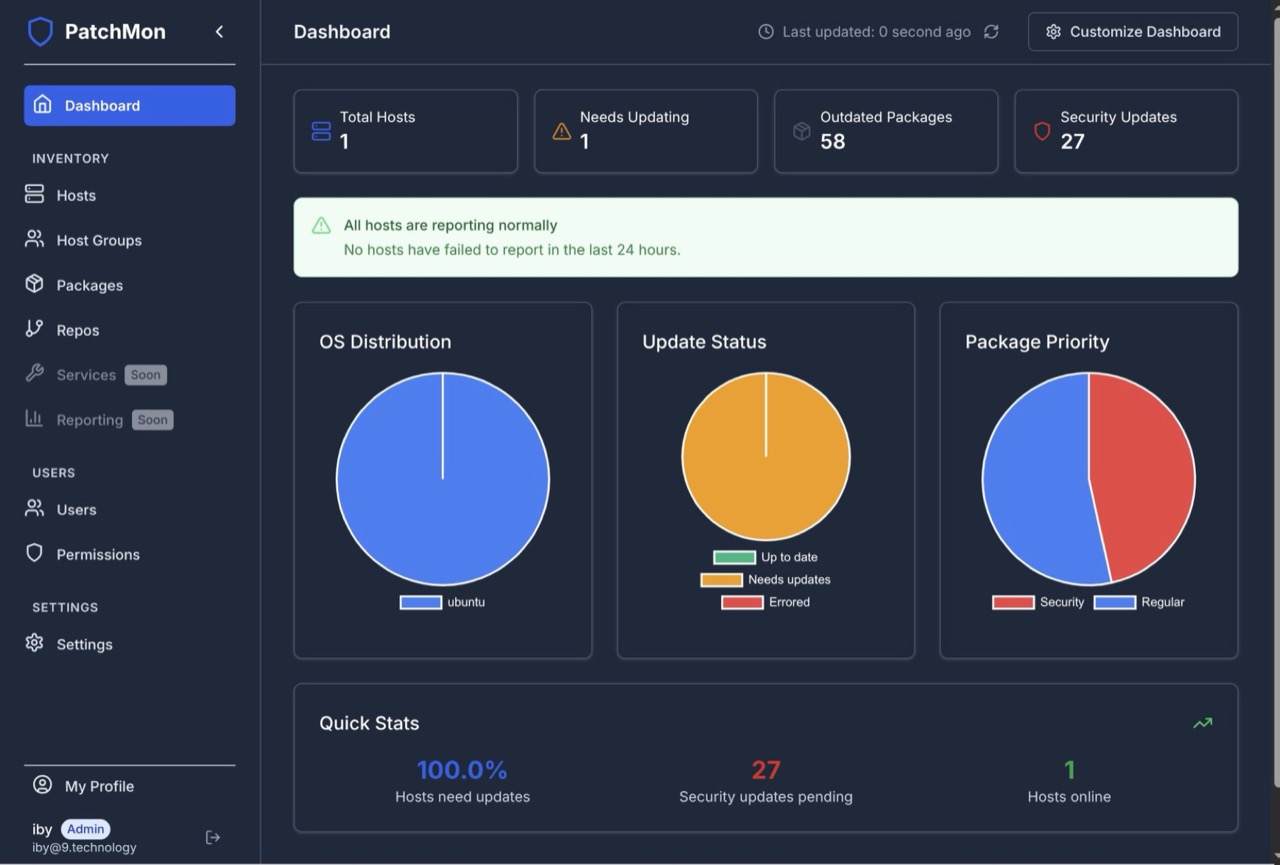
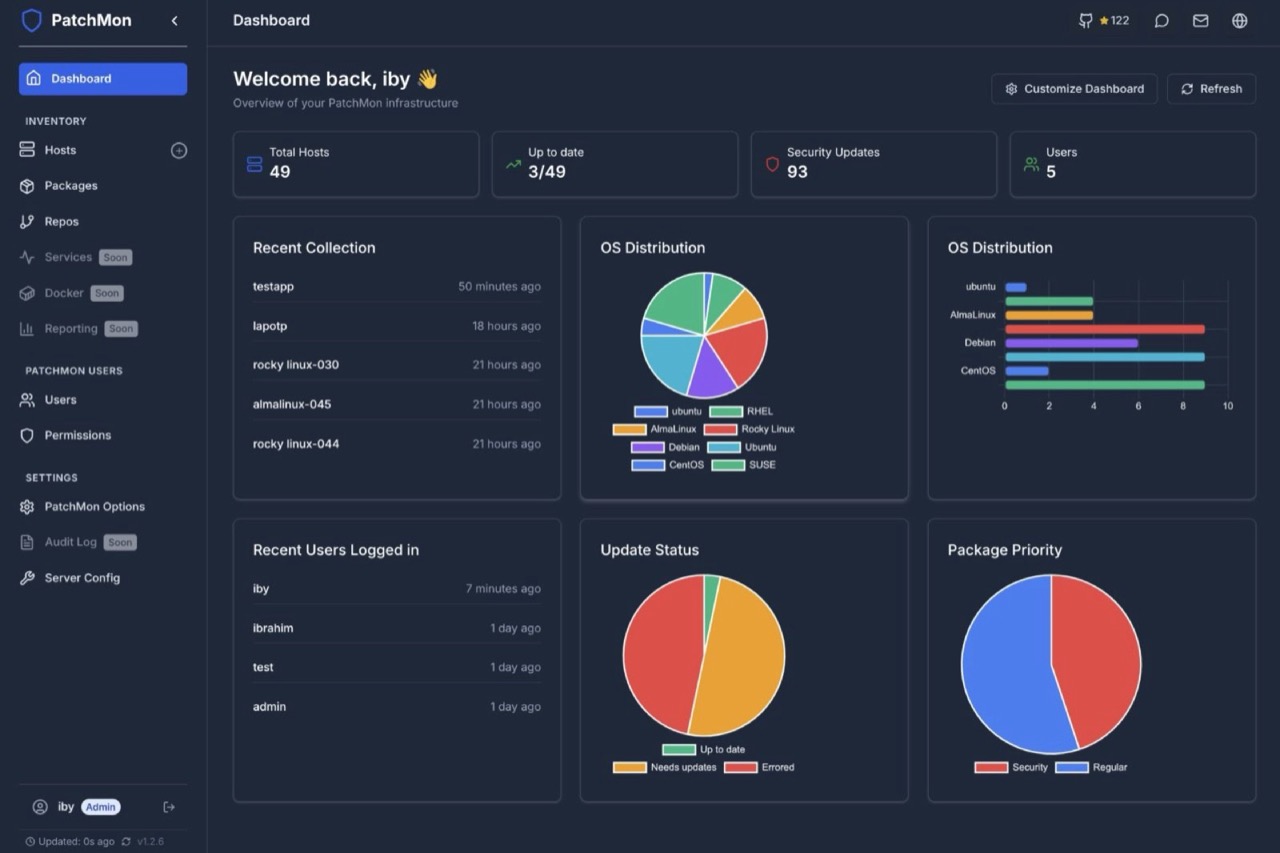
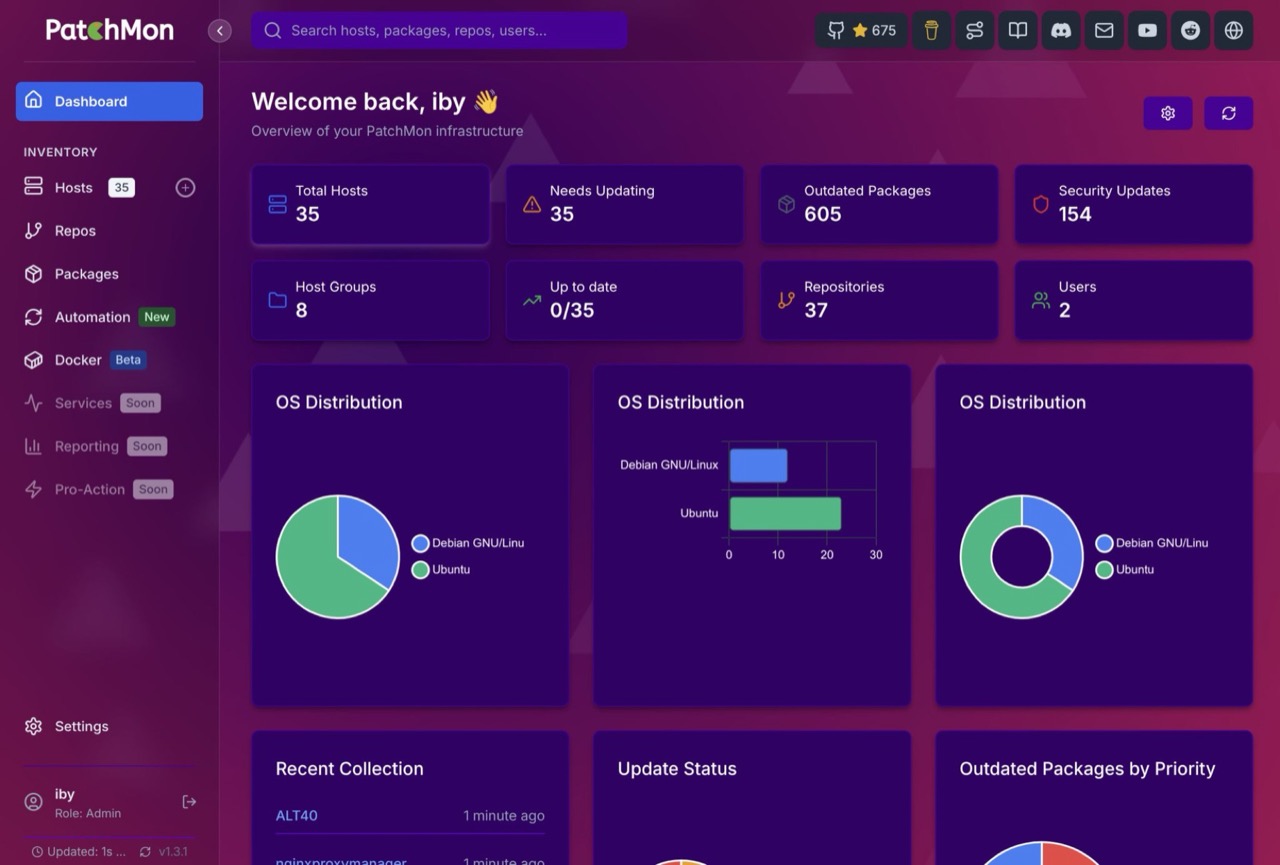
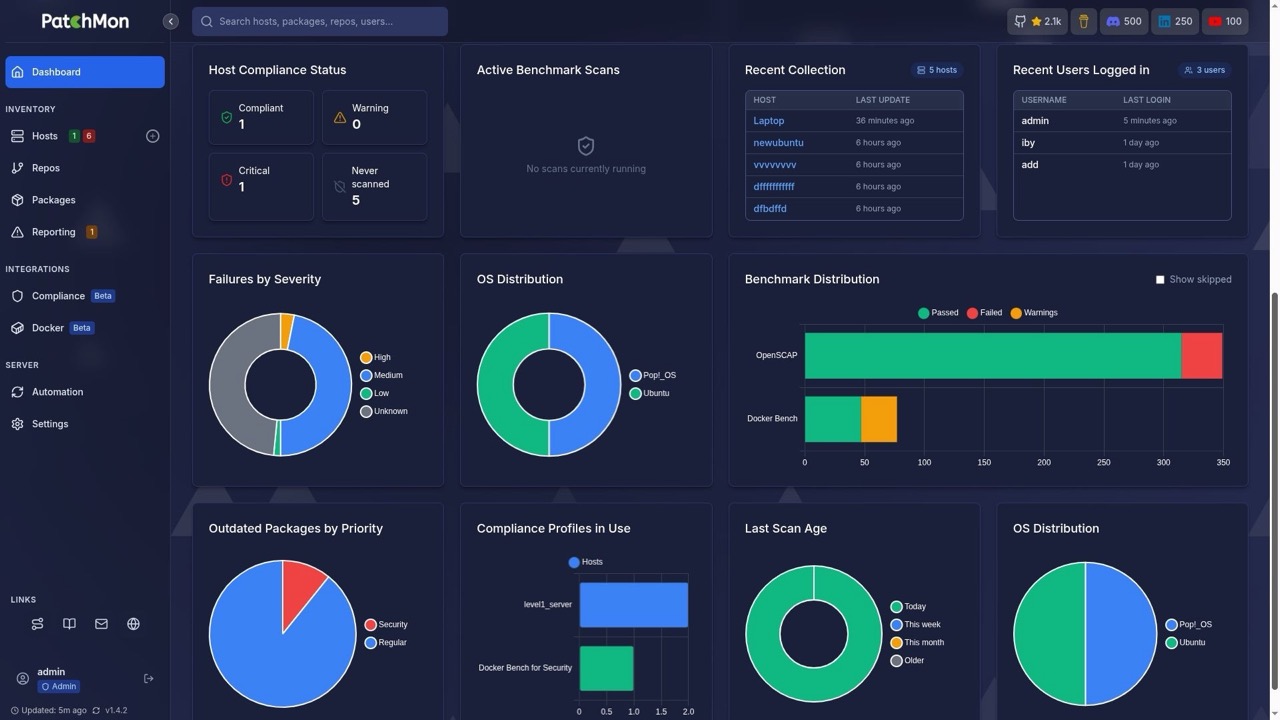
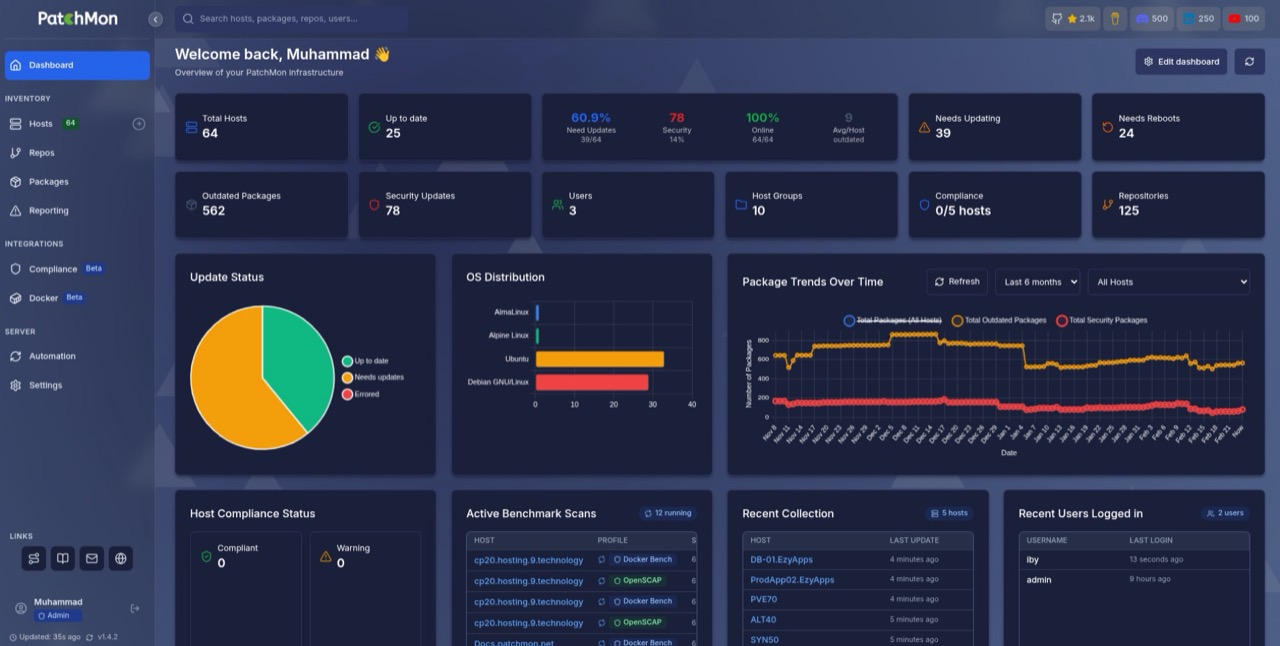
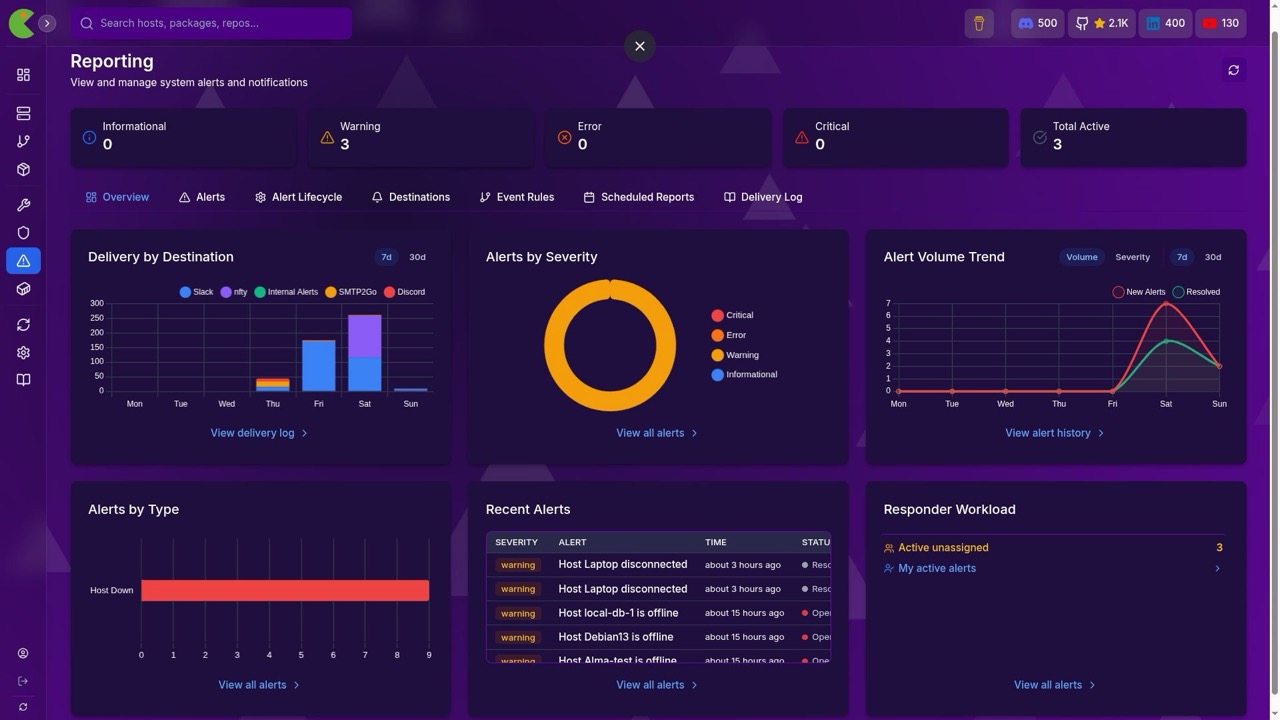
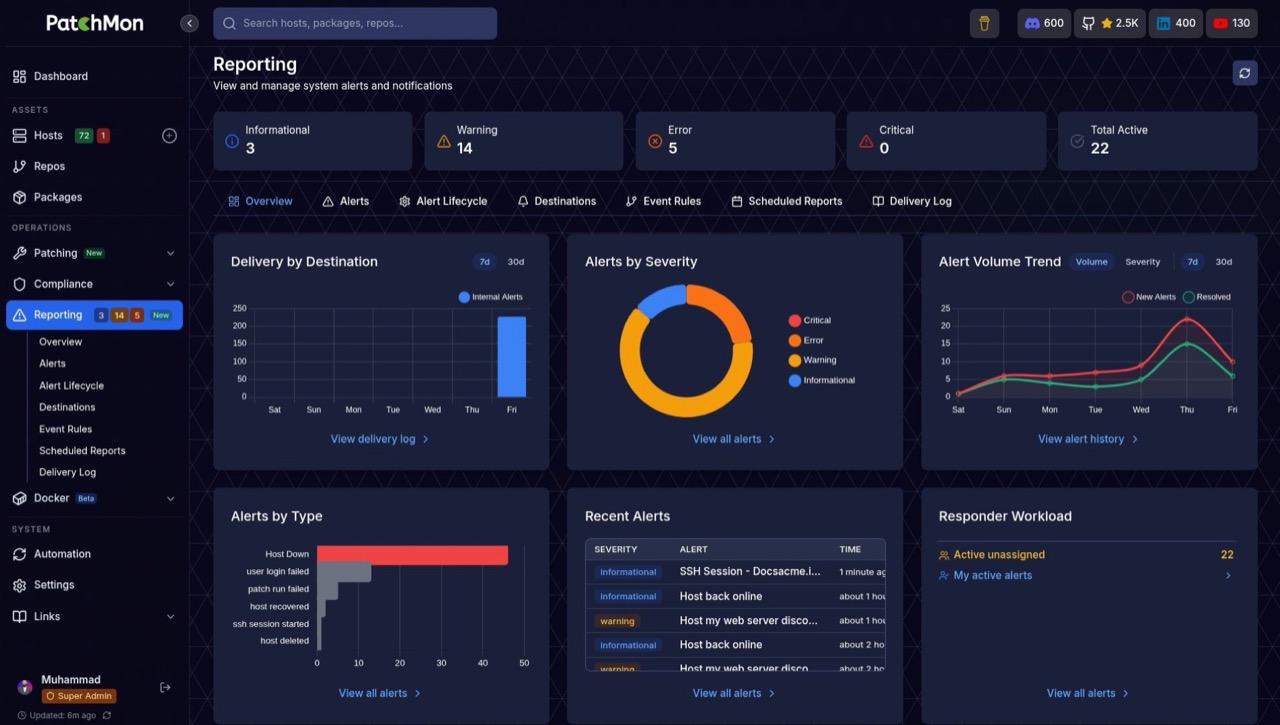
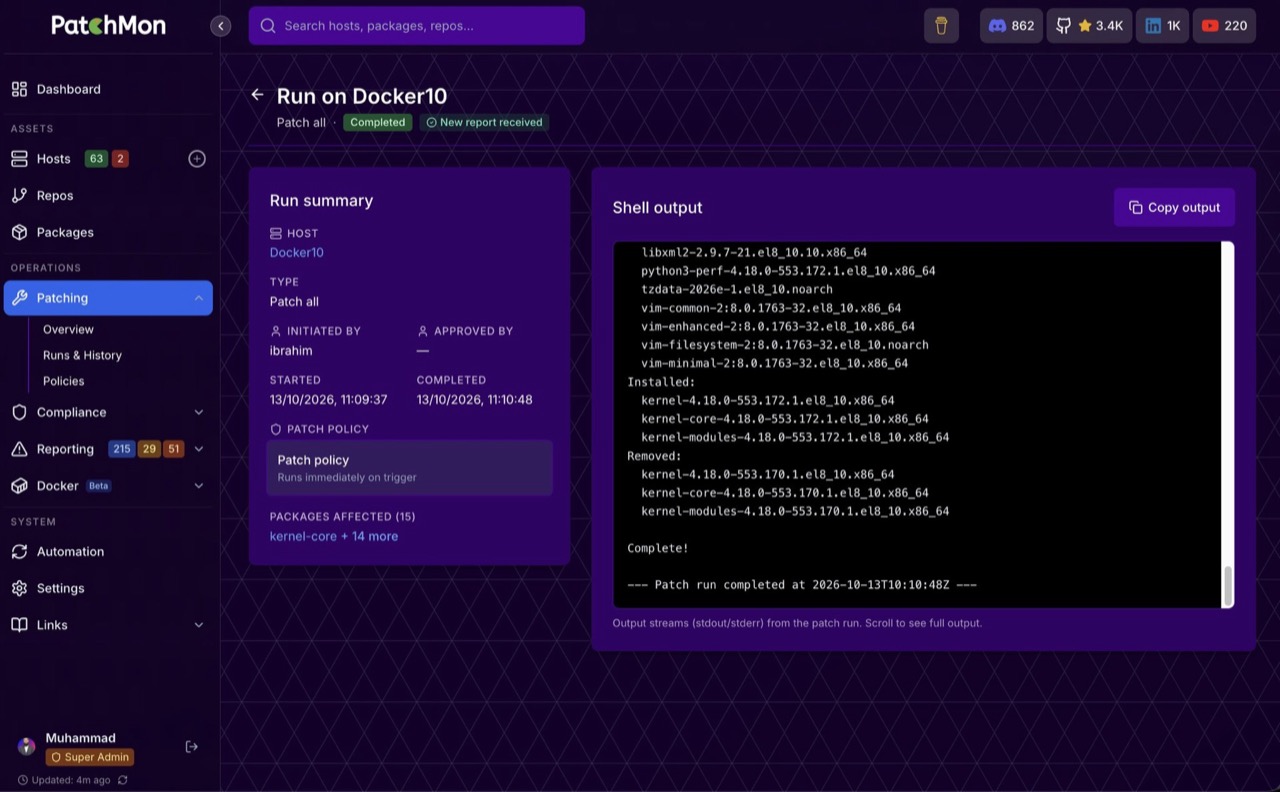
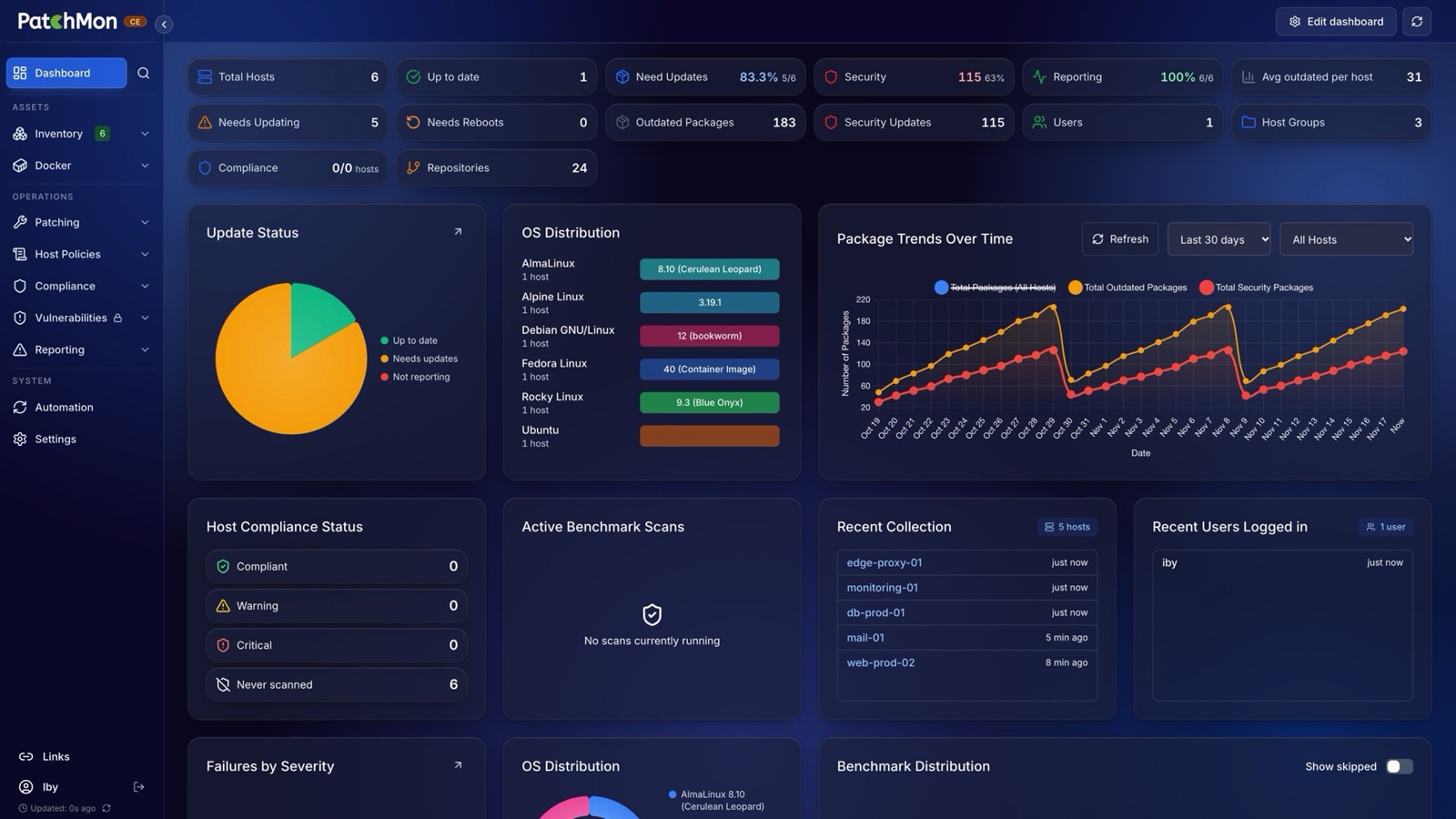
The first dashboard. No login yet.Dark mode and a real sidebar.Users, recent collection, more charts.Themes arrive.Compliance and benchmark widgets.Package trends over time.Alerting: destinations, severity, trends.Reporting grows up.Patching: live shell output from a real run.2.2: the glass interface.
Accurate. Useful. And it leaves the hard part to you.
Prescriptive: what should I do next?
Patch web-prod-01 first: a kernel CVE in CISA's exploited list.
Then the 12 hosts still serving PHP before 8.4.27.
Reboot 3 hosts in tonight's window; 24 can wait.
Patch these 13 hosts
Illustrative example.
Operational visibility → operational intelligence
Climbing the ladder
what's there?
Visibility
Every host, package and repo.
what's wrong?
Awareness
Outdated, security, reboot pending.
what matters?
Priority
CVEs, exposure, what is exploited.
fix it
Action
Patch runs, reboots, validation.
fix it, safely, by itself
Intelligence
Policies, orchestration, auto-patching.
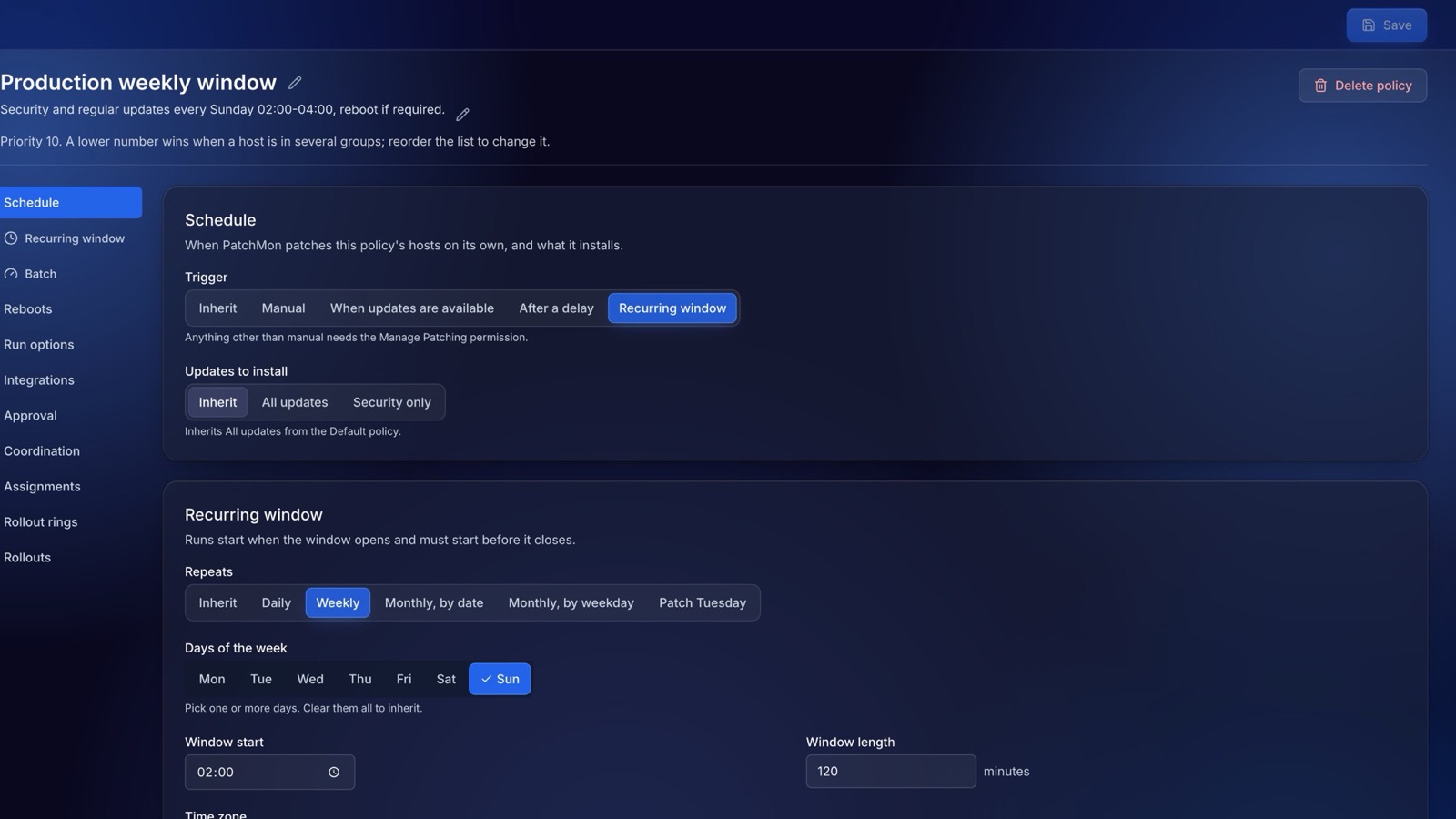
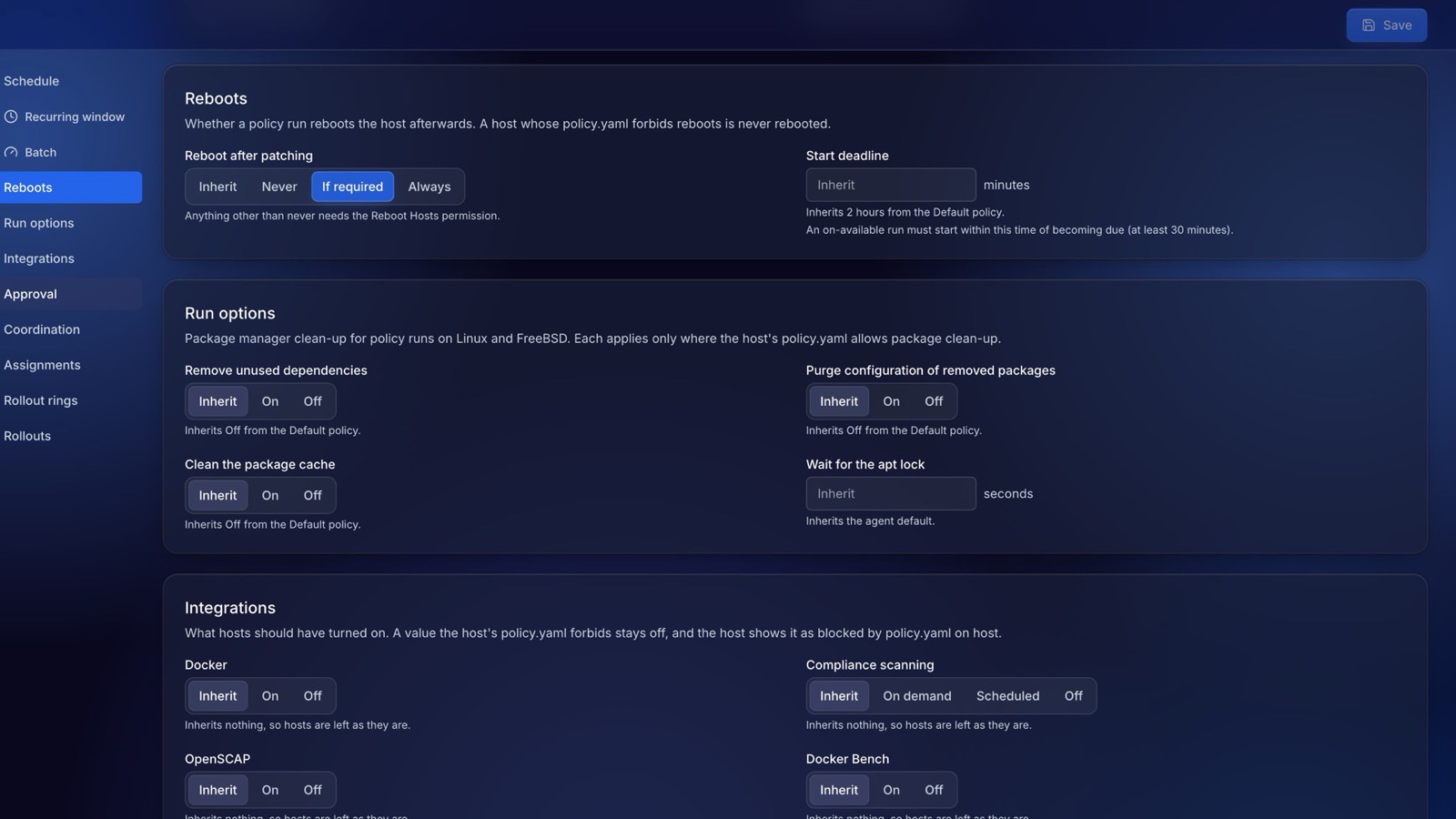
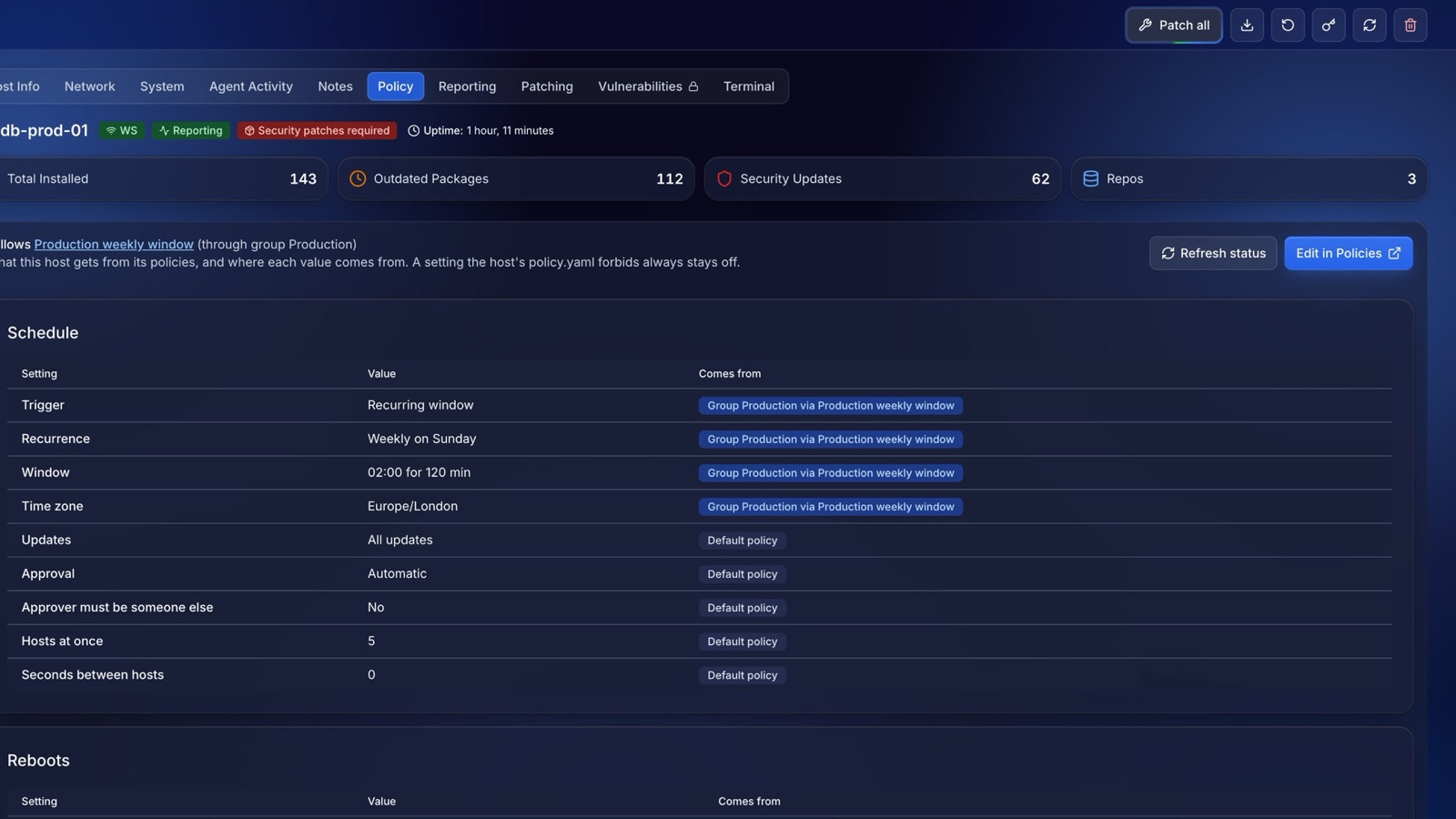
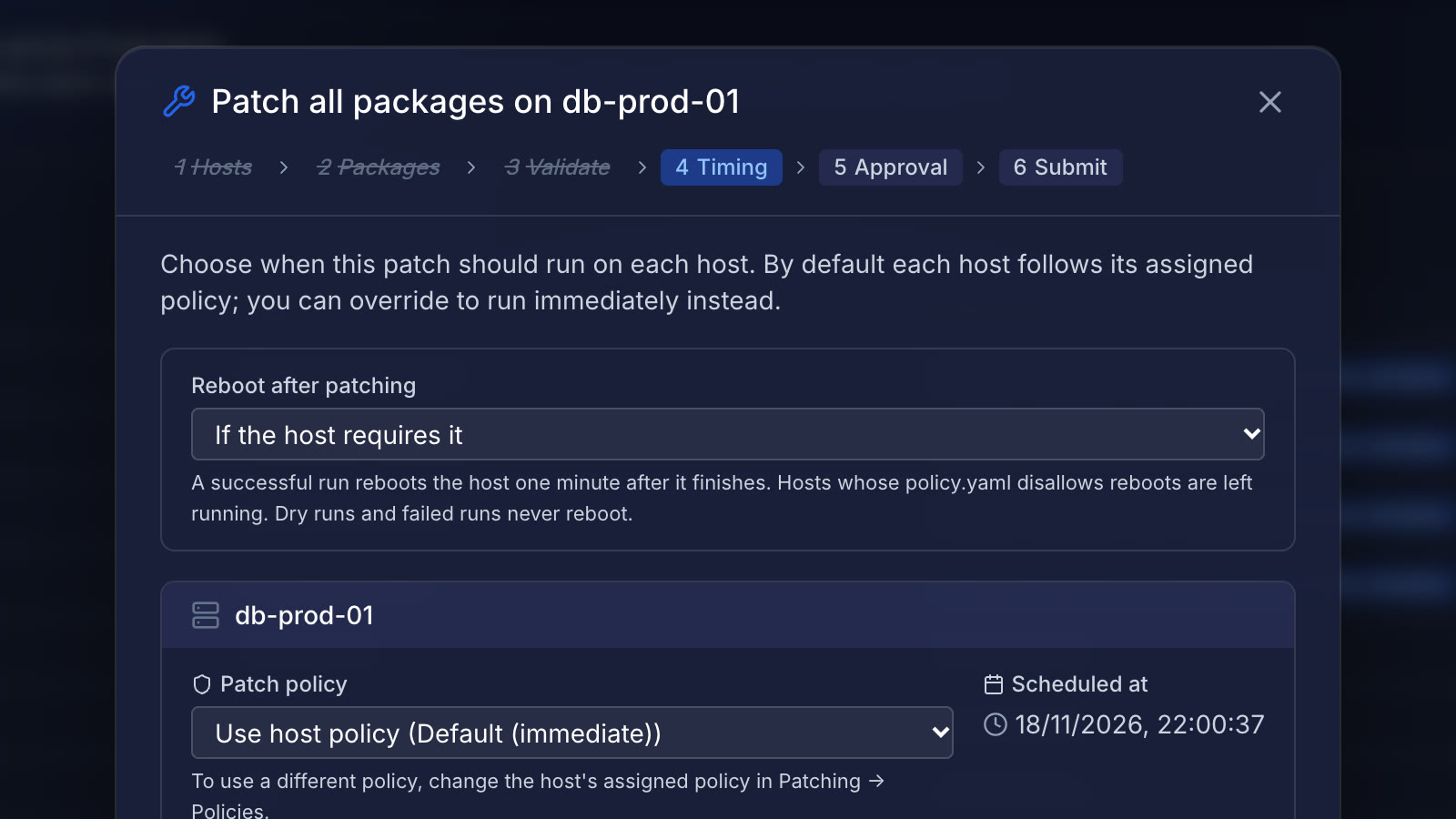
Host policies
Patching on autopilot, brakes where you want them.
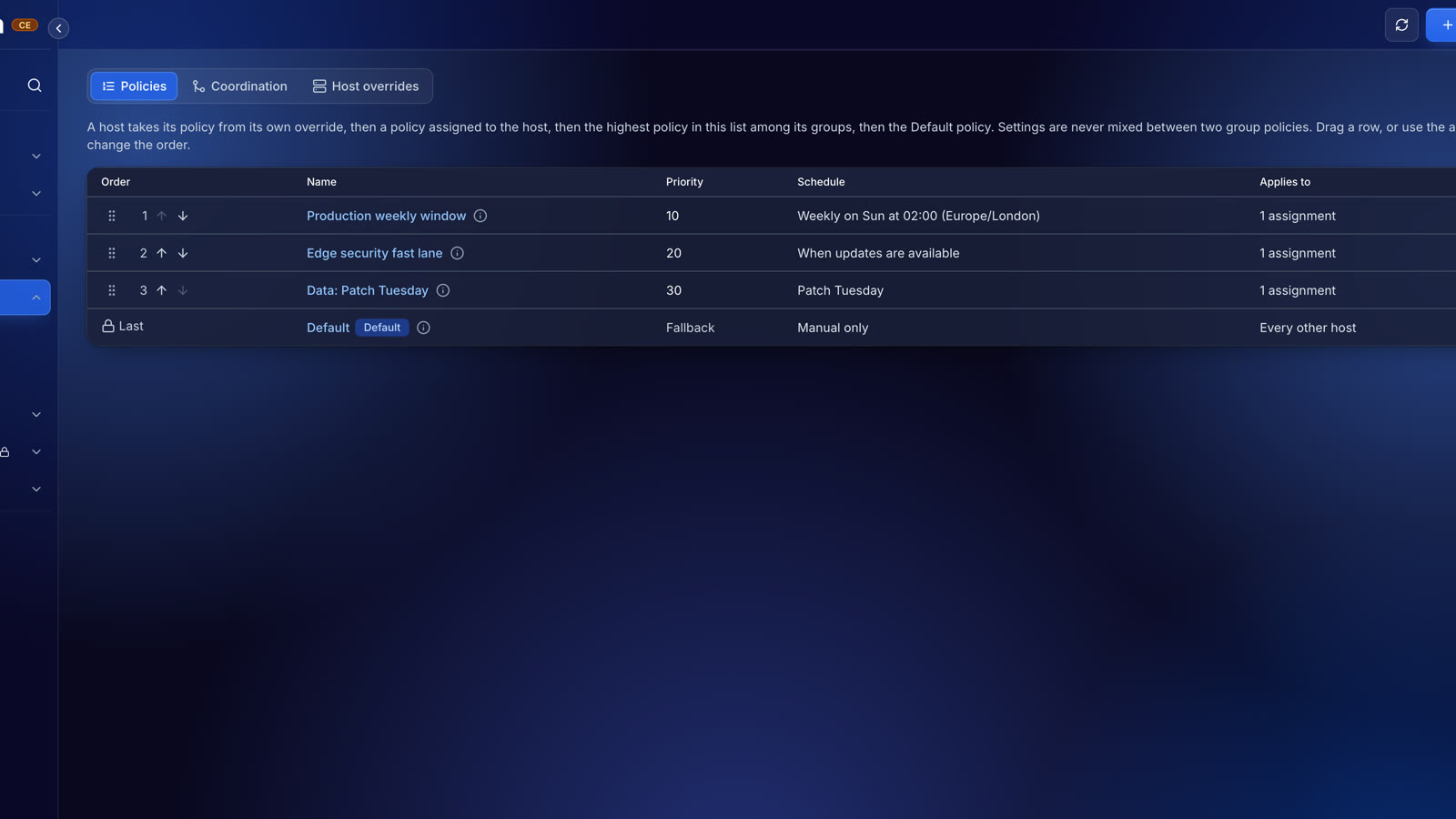
Policies are ordered: a host's own override, then its policy, then its groups' highest policy, then Default.Schedules: manual, when updates appear, after a delay, or a recurring window. Weekly, monthly or Patch Tuesday.Reboots: never, if required, or always. Batches, start deadlines, clean-up and scanners per policy.On every host: which setting applies, and which policy or group it came from.Ad hoc runs still work: Patch all, pick the timing and reboot behaviour, approve, queue.
Demo: a tour of PatchMon 2.2
Demo instance: six real agents on fictional hosts. Trend history before today is seeded demo data.
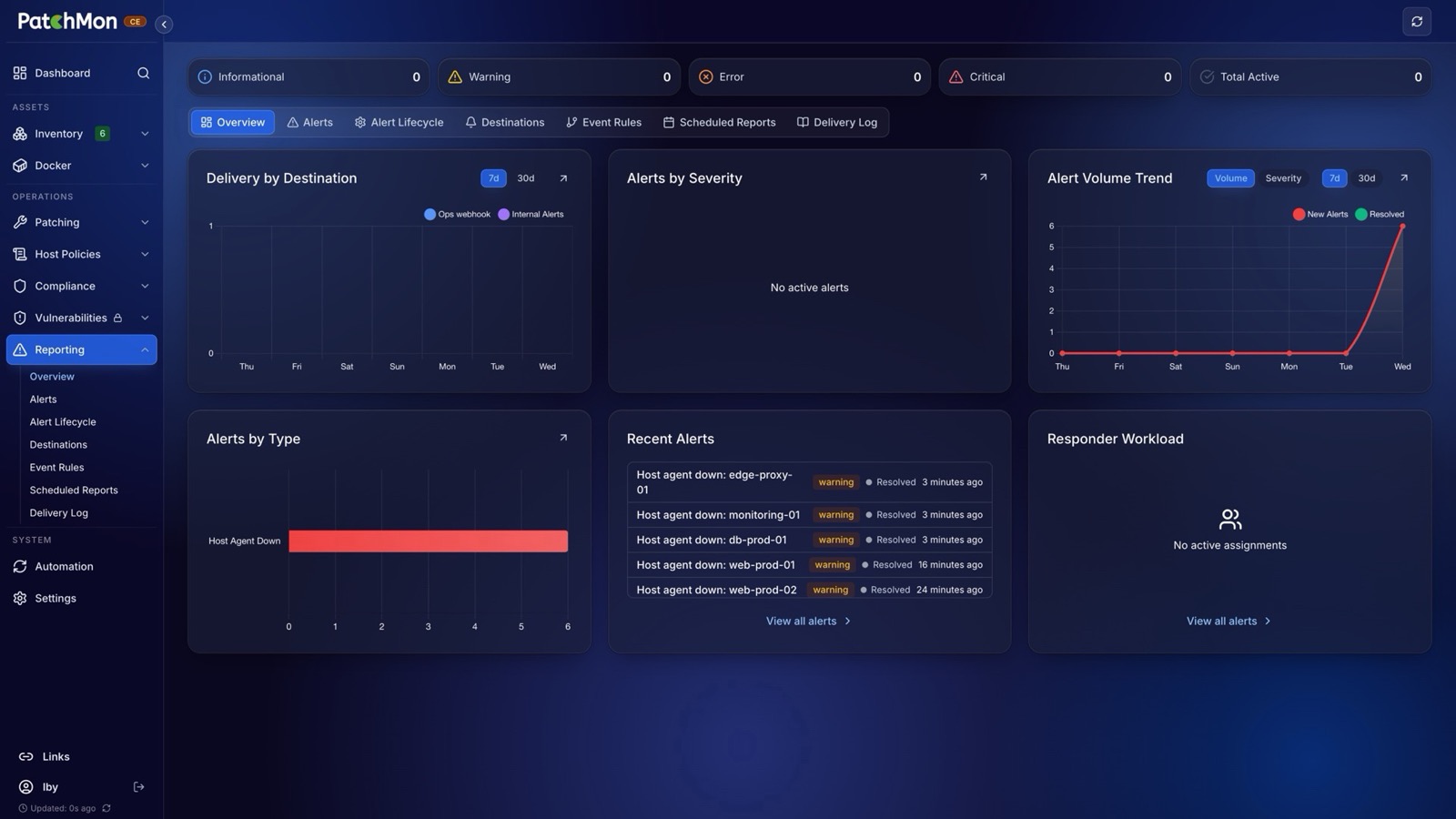
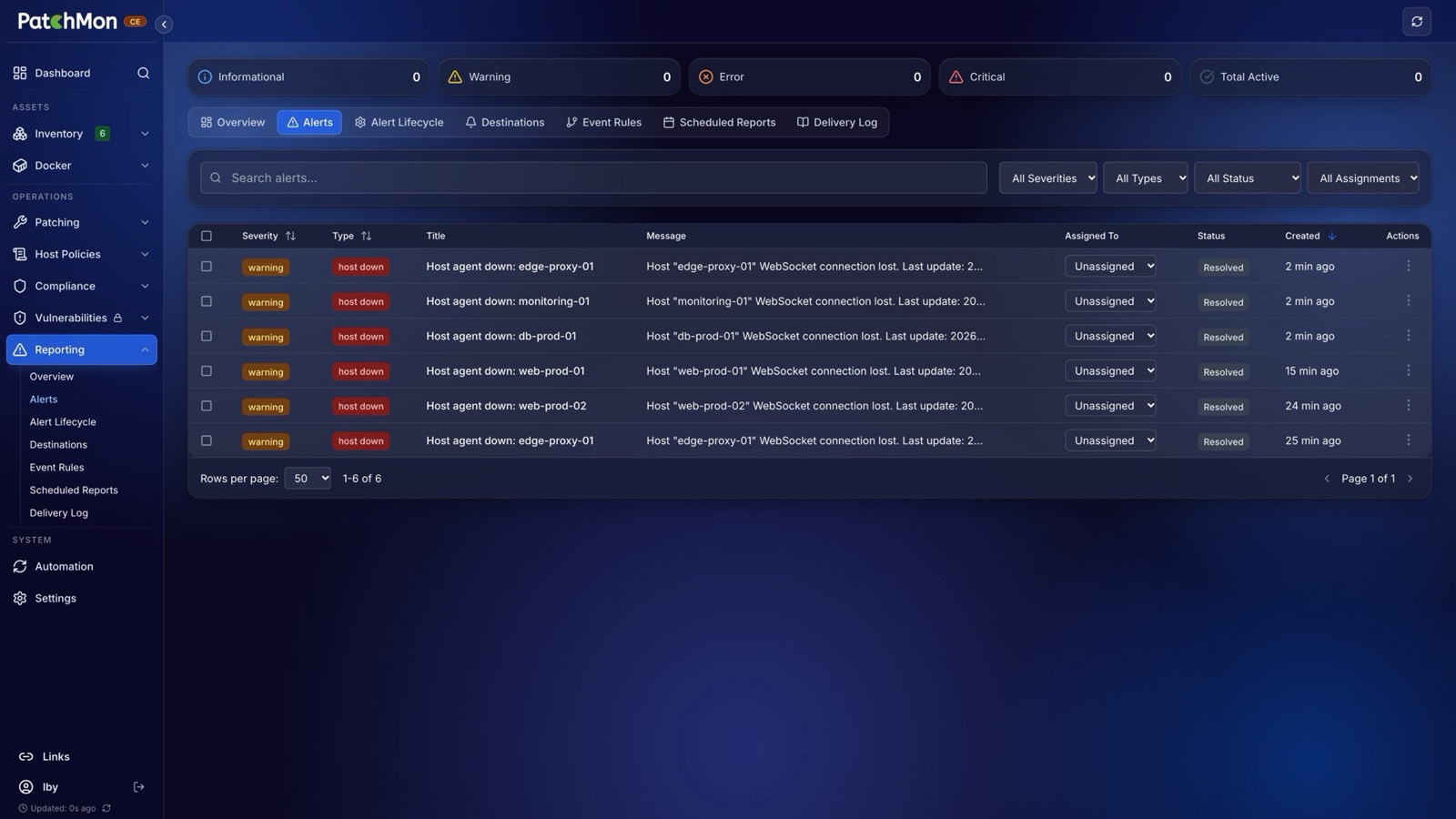
Alerting
Know first. Route it where you already look.
host down and recoveredpatch run completed or failedsecurity updateswebhooks, Slack, Discord, ntfy, emailalert lifecycle and assignment
Live, no safety net
Let's patch a real server.
# what you'll see
1. web-prod-01, Debian 12, updates pending
2. Patch all
3. the live shell output streams in
4. packages now current
5. reboot flag, if the kernel moved
Host down, security updates, reboots, routed where you already look.
Uses your package manager
apt, dnf, yum, apk, pacman, pkg and winget. No custom repos, no magic.
AI help in the SSH terminal
Ask what a command does before you run it as root.
Logos are trademarks of their owners. Grafana, Prometheus, Icinga and NetBox are on the roadmap, not shipped yet.
Mature, supported, audited
Open source, with a company behind it.
ISO/IEC27001Information security
ISO9001Quality management
ISO/IEC42001AI management
Enterprise support
PatchMon is provided by 9 Technology Group Ltd. Trust Centre: trust.patchmon.net
9 Technology Group Ltd is certified to ISO/IEC 27001 and ISO 9001. The scope of certification is stated on the certificate, available in our Trust Centre. 9 Technology Group Ltd is also certified to ISO/IEC 42001.
What's next
PatchMon 2.2 lands 1 January 2027
1 January 2027
macOS agent
Alongside Linux, FreeBSD and Windows.
1 January 2027
MCP server
Ask your fleet questions from your AI tools.
1 January 2027
Auto-patching
Schedules, reboots and orchestrated roll-outs.
1 January 2027
CVE mapping
Every package matched to CVEs, via cveapi.net and cve.ms.
1 January 2027
Host exposure
What's actually reachable, so priority means something.
1 January 2027
Dashboards
Build your own. Just one more.
after 2.2
NetBox, Prometheus, Grafana
Integrations for the tools in this room.
We'd love to hear from you
What we're looking for
Integration partners
Your tool plus our patch data.
Beta testers
Try 2.2 before 1 January.
Community
Discord, GitHub, the feedback board.
Thank you
osmc.patchmon.net
2.2 updates, early-bird pricing, the beta, stickers, and these slides.
Over to Mattias →
First, a quote
"Gardens are not made by sitting in the shade."
Rudyard Kipling
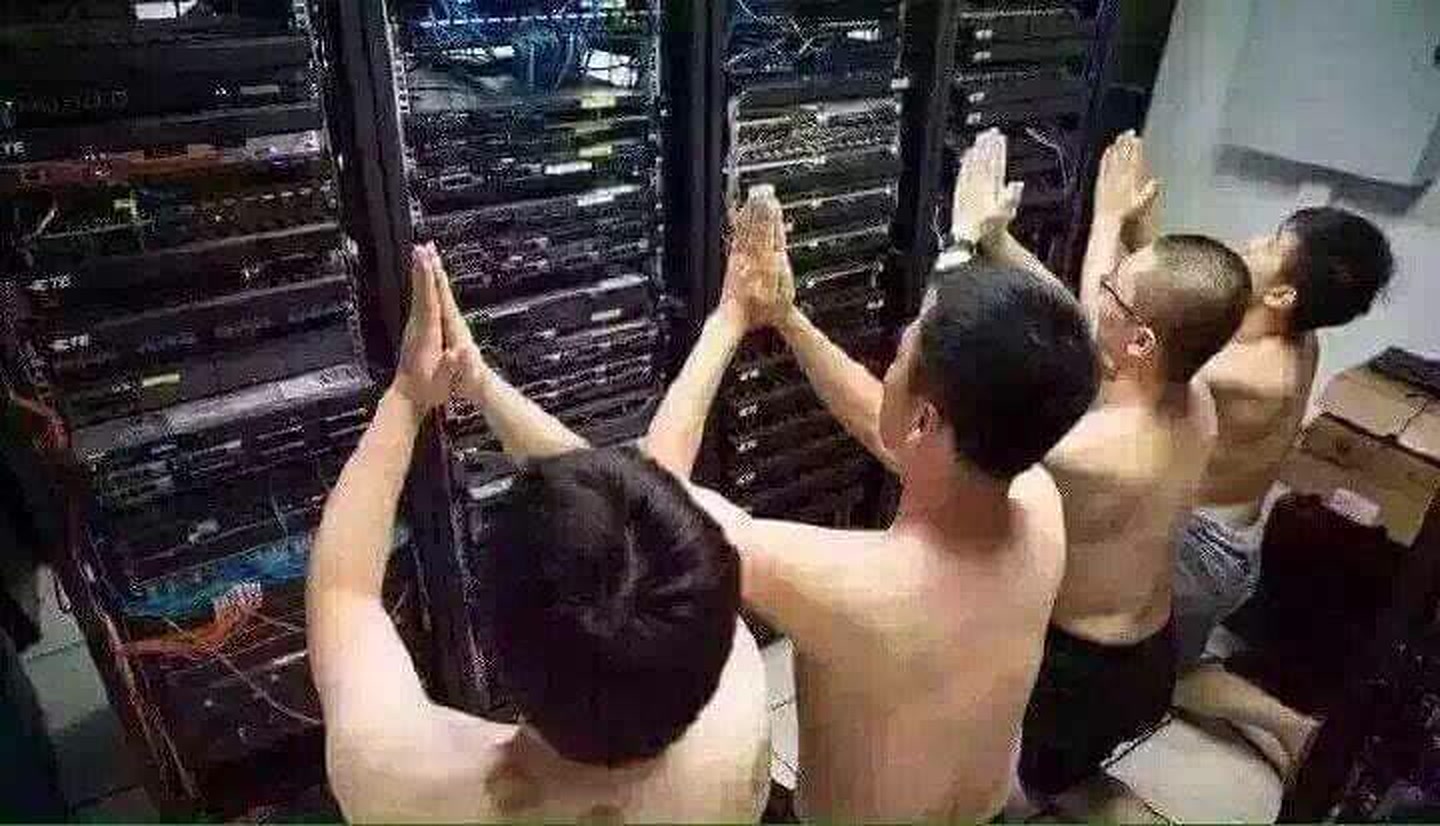
A quick meme break
root@prod-web-01:~# uptime
09:41:07 up 847 days, 3 users
root@prod-web-01:~# uname -r
5.15.0-58-genericroot@prod-web-01:~# apt list --upgradable | wc -l
212
847 days of uptime
is not a flex.
It's a confession.
Shipping cadence
0 GitHub releases in 15 months
3Sep 25
4Oct
4Nov
1Dec
0Jan 26
3Feb
0Mar
3Apr
0May
0Jun
0Jul
4Aug
0Sep
3Oct
2Nov
GitHub releases API, PatchMon/PatchMon: v1.2.4 (18 Sep 2025) to v2.1.8 (6 Nov 2026). The quiet months were the Go rewrite and the patching work.